Prolepsis

[Leer cuento en español]
[Ler a história em português]

When he goes to get fresh air on the balcony, Phil is immersed in the everlasting dance of the treetops that strain to mask the urban reality of cement and brick. His light red hair may not take any more walks than is fair and necessary; but his mind knows no such restrictions: this greenery hypnotizes him once more, and his imagination runs wild until he sees —feels— the eternally-damp soil of London under his shoes, the lavender twitching in the wind, and the tiny hand of little Colin, who in turn intertwines the fingers of his other hand with Adrien’s.

On the way to the urban farm, Colinho is jogging alongside his parents, chattering about how his first day of preschool went and endlessly asking why, why, why. Phil entertains him by teaching him the numbers in Portuguese, Adrien fills his ears with little French stories, and then they hum Thinking Out Loud, because they always find a chance to sing their song. At the farm, Colinho laughs out loud and starts suddenly at a growl and goes through the names of the animals in all the languages of his universe. When his son craves a treat, Phil realizes he doesn’t know if his choice would be a muffin, an éclair or a brigadeiro, and this uncertainty pulls him out of his reverie.

The interruption does not bother him, however, because the return to reality becomes a delightful limbo where the time he spends in the treetops passes in slow motion. He is struck by how his subconscious always chooses the most British names that exist (today he had a Colin, but yesterday he imagined a Prudence, Thursday a Freddy and before that a Daisy,) and he finds it very funny how right away, he lusophizes them, as if his mother tongue reasserts itself almost indignantly after his years and years of residence in England.

His return to reality becomes complete with the ping of a new email. Every time the name of the social worker pops up on his screen, his heart skips a skip, he crosses his fingers, calls Adrien (“a message from Ginnie”), and the two steam open the digital missive together. They sigh: once more, news without news, yet another joint interview.

They never quite know what the next appointment with Ginnie will bring. Adrien is a bit short with words, but for the talkative Phil there is always more and more and more to discuss. In the individual interviews, over a rambling two hours, he outlined in painstaking detail his favorite uncle’s love life, the feuds that characterize the dark side of his family history, and how his grandmother defied the rigid social norms of 1960s Brazil when raising her daughters. The joint interviews force them to stare deep into each other, to confess beliefs they had not even realized they had before, and to decisively make distant and intangible decisions. And it’s not just exploring each other: with each meeting, Phil and Adrien feel like they’re delving a little deeper into their own depths.

Despite their initial fears, the pandemic has actually given them certain advantages in the process. Meetings with the social worker before the lockdown meant both were obliged to ask for a day off work, arrive with very British punctuality, comb their hair, dress up and conceal any nervous tics that should suddenly manifest. But now everything is much easier, because Skype appointments are easily fit within the workday, haircuts are less scrutinized, and talking from the warmth of home brings a more relaxed atmosphere.

At the last interview, Ginnie warned them that during the next stage they would have to decide the age. In the event that they opted for a baby, one of them would have to stop working for a year, but their company would only grant them thirteen paid weeks, but London is very expensive and they do not have that much savings, but they could pull it off if they moved to a cheaper flat, but moving is a sign of inconsistency and the adoption agency demands rock-solid stability, but maybe with government assistance, but all this would only be affordable for Sir Elton Hercules John himself.

In the next interview, they will have to talk about why they want to adopt. That’s what Ginnie tells them, as well as the date and time, which they confirm immediately. Adrien grumbles and walks back inside; Phil prefers to do his grumbling on the balcony and searches and searches for a slightly less hackneyed reason that he can give. Before leaving the breeze on the balcony, Phil takes one last look outside and feels a certain friction between the overwhelming inactivity of those streets (where nothing seems to be happening) and the elation of the imminent change that will come in weeks, months, a year? Unlike the world out there, their lives are filled with speed and excitement.

Today it’s Adrien’s turn to cook and, since he knows that Phil tends to melancholy, and that he misses the nights out in Camden, he has prepared fish and chips, just like at Poppies, accompanied by a pint of beer and the best songs from his favorite bar, The Hawley Arms, temporarily closed, but reopening today only in a nondescript London home. To avoid dwelling on Ginnie’s questions and the fears, expectations and challenges of parenthood, they catch up on how telecommuting is going: Adrien has been putting together a hummus commercial for the Luxembourg market, and Phil has been collecting drawings from their friends’ kids to appear on the television channel where he works. As their social life extends only to their counterpart, the conversation chosen for this special evening soon peters out, and they cannot prevent the future from returning to their lips, and they find themselves talking of when the three of them will go to Mantes-la-Jolie to visit Adrien’s parents, of what a good example Phil’s loving goddaughter, Lily, will be, when they visit Petrópolis to officially present the new member of the family, of the living room dance sessions to the rhythm of the Spice Girls.

Every night—even Camden nights—the couple watches a show, and today they’re in luck: they have a new episode of one of their favorites. But at six minutes and sixteen seconds, Adrien is already sound asleep, as usual, so Phil has to resign himself to finishing Killing Eve tomorrow, because he knows the moral code of their sacred union has some immutable tenets and thus that he cannot watch even one more scene by himself. More nocturnal by nature, Phil still has a long time before exhaustion will set in.

Since Friends doesn’t do anything for Adrien, Phil spends two episodes stifling his laughter at every single joke, even though he knows them by heart. Between jokes, he glances out of the corner of his eye at his husband, who, when he sleeps, overflows with tenderness and seems centuries younger. Little by little, he curls up next to him, and Adrien’s body turns automatically to snuggle up, as if magnetized within the sleepy inertia of his idyll. At that moment, as every night, Phil falls asleep with the absolute certainty that their bodies fit perfectly, and he remembers Colinho and Prudencenha and Freddinho and Daisynha, and his eyelids surrender to nostalgia for the future.

{Translated by Adam Lischinsky}

~~~~~~~~~~~~~~~~~

More tales of the pandemic based on real stories at
Love in the Time of Coronavirus,
by Patricia Martín Rivas
Love in the Time of Coronavirus

Art Bites Paris

The Oath of the Horatii
Jacques-Louis David, 1784, Louvre Museum

Let’s face it — most visitors go to the Louvre Museum to see the Mona Lisa (or, more specifically, to take distant blurry photos of this overrated painting). Most of them also leave the museum without seeing many important works of art, amongst them The Oath of the Horatii. This is one of the greatest works of Neoclassicism, a movement based on the aesthetic values of old Greece and Rome for which symmetry and detail were paramount. In this huge painting, David depicts a 7th century BC story with only nine characters: the three overly-patriotic Horatii (on the left) lift their swords and swear to their father (in the middle) victory or death, leaving their mother, wives, and kids (on the right) in sorrow, perhaps for the last time. The tension is eased by the geometry, and the intricacy is simply breathtaking — one could spend hours merely contemplating the details on the leg of the first Horatius.

Luncheon on the Grass
Édouard Manet, 1863, Musée d’Orsay

Parisian salons in the 19th century had the crème de la crème of French society and no shortage of scandals — especially in the Salon des Refusés, to which the worst works were banished. Luncheon on the Grass was rejected by the biggest Parisian salon, but even in the Salon des Refusés, it had a lot of detractors who insisted that it be taken down. Perhaps it was the first time they’d seen a naked woman in a painting? Well, obviously not, but always before it had been an idealized, unreachable goddess. Their impression from this painting was that that naked woman was nothing more than a prostitute, and that was outrageous — at least, to show. The alleged infamy of the piece didn’t stop it (or maybe helped it, actually) from becoming one of the most iconic paintings in the history of art, and one of the most imitated. There is, for example, a 1964 version of Luncheon on the Grass (with the same name) in the Centre Pompidou, by the French pop artist Alain Jacquet.

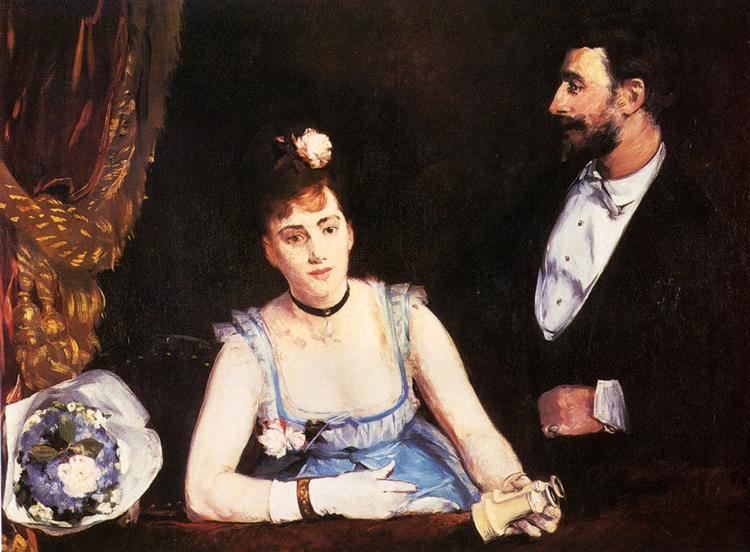
A Box at the Theatre des Italiens
Eva Gonzalès, 1874, Musée d’Orsay

Even if she never exhibited any of her works with the Parisian impressionists, Gonzalès’ style led her to be considered part of this movement — after all, even her teacher, Manet, was excluded from these exhibitions. Very few women are acknowledged as part of the history of art, but there were some bright lights amongst the impressionists — most notably three, Eva Gonzalès, Mary Cassatt and Berthe Morisot, and many of their works are in the Musée d’Orsay. They normally depicted women in a domestic atmosphere (many times with children), since that was, after all, their main role in society. Gonzalès learned from Chaplin and Manet, but she soon developed a very personal style, creating intense portraits full of emotion. In A Box at the Theatre des Italiens Gonzalès chose a public atmosphere but made it very intimate, due to the black background and the amazing detail in the clothing and accessories of the two people depicted. These two characters — in reality, her husband and her sister — seem to have a distant relationship and to be very close at the same time, and the woman’s expression is especially interesting due to its ambiguity. Unfortunately, the artist died after giving birth to her child when she was only 34, and her husband actually ended up marrying the sister pictured in the painting!

A Box at the Italian Theatre, 1874 - Eva Gonzales

Dada Head
Sophie Taeuber-Arp, 1920, Centre Georges Pompidou

Even in the frantically hyper-modern 20th century, only a few women were allowed into elite artistic circles. Painter-dancer-weaver-designer-photographer-etc. Sophie Taeuber-Arp was one of the lucky ones and was accepted in the male-dominated Dadaist world. One of her most famous works is her series of heads, some of which can be seen in the Centre Georges Pompidou. The Swiss artist considered these colorful wooden heads on pedestals to be parodic portraits and functional hat-stands. Apart from mentioning Dada in some of them — as all dadaists tended to — she simplified the main concept by creating abstract geometric interpretations of reality, avoiding any physical or real resemblance. Some of them also resemble African masks, an influence on many artists of the day, starting with Picasso.

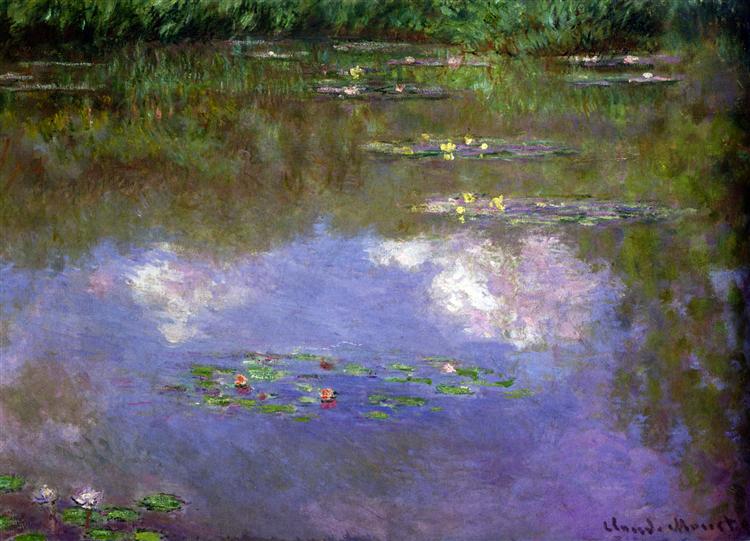
Water Lilies: The Clouds
Claude Monet, 1920-1926, Orangerie Museum

In the last 31 years of his life, French artist Claude Monet painted around 250 versions of the water lilies of his garden in Giverny, in the north of France. Nowadays many are scattered across the the important museums of the world, but one of the most impressive ones is the one in the Orangerie Museum, with dimensions of 2 x 12.75 meters. The immense size is not the only factor that makes one feel inside the work, as the amazing technique irresistibly attracts the viewer to its beauty. Monet’s Impression, Sunrise was the painting for which Impressionism was sarcastically named. This movement was mainly based on capturing light and studying how as light changes, vision (and thus the artwork) changes correspondingly. He also painted 30 different versions of the Rouen cathedral between 1892 and 1894, some of which can also be enjoyed in Paris, at the Musée d’Orsay.

Water Lilies, The Clouds, 1903 - Claude Monet

Ingres’s Violin
Man Ray, 1924, Centre Georges Pompidou

One of the main practices in the explosion of artistic creativity in the first half of the 20th century was appropriation, which essentially means transforming an artistic reference piece into a new work of art. Emmanuel Radnitzky, better known as Man Ray, did this — many times — including in this 1984 work where he modified one of the most famous representations of an Odalisque (the original work, by Ingres, is currently housed in the Louvre).

In a punny reference to the French idiom “le violon d’Ingres,” meaning a hobby, the American Man Ray painted the characteristic f-holes of violins on the French artist’s photograph of a practically naked woman (his lover, Kiki), her whole back exposed. Then he photographed the slightly altered photograph and, voilà, his glorious new interpretation was complete.

The modernist American artist spent most of his career in the artistic circles in Paris where he experimented alongside Dadaists and Surrealists and created his famous Rayographs, photographic images made without a camera.

Plaque décorée d’une Infante (Les Ménines)
Pablo Picasso, 1957, Picasso Museum

“Good artists copy, great artists steal,” Picasso said. He was obviously a genius, so he stole a lot — as well as creating, of course. In the museum dedicated to his work in Paris (a city where he spent many years of his life), one can admire a lot of his works, both original and stolen. Picasso is known worldwide for his great contribution to the development of modern art, especially cubism, and applying his characteristic style — solidity, flatness and different perspectives — to reimagine old works of art. In this case, Picasso made a series of 58 paintings of the famous Las Meninas, by his compatriot Diego Velázquez, whom Picasso admired deeply This entire series is in Barcelona, but he also painted some of the characters independently on different materials, like ceramic here, some of which can be found in Paris. And though he termed it stealing, these versions of Las Meninas have strong character and a whole new perspective, breaking all rules of representation.

Portrait relief de Martial Raysse
Yves Klein, 1962, Musée d’art moderne

Yves Klein was linked to movements like Pop Art and Neo-Dadaism, which was actually a reaction to the introversion of Abstract Expressionism. He quickly became one of the most influential artists in the 20th century — not only influencing art but fashion! In 1960, he created and patented a color named IKB (International Klein Blue) and used it in a lot of his artworks, such as in his bronze and gold paper Portrait relief de Martial Raysse, where he recreates a classic sculpture giving it a powerful new meaning using only IKB. The color has become very common nowadays. In the late 1950’s, he also did a remarkable performance called Zone de Sensibilité Picturale Immatérielle, which consisted of exchanging “zones of immaterial pictorial sensibility,” certified with a cheque, for gold that he immediately threw into the Seine. So Dada!

The inhabitants of the Hôtel de Saint-Aignan in 1939
Christian Boltanski, 1998, Jewish Museum

The half-Christian half-Jewish artist Christian Boltanski was born in 1944 in Paris, and he met many Holocaust survivors growing up, so the terrible European genocide — alongside memory and human nature — is the leitmotiv of his work. In The inhabitants of the Hôtel de Saint-Aignan in 1939, he created an installation in the former hotel, then Jewish residential building, then Jewish Museum in the Marais, the Parisian Jewish, and now gay, quarter. His work doesn’t directly confront the unfathomable killing, but instead suggests and personalizes it. It consists of small signs, each containing a person’s name, job, and origin. Sometimes there’s also a date of death, but when there’s none, this may mean the person either escaped or disappeared — it is certain that a total of thirteen inhabitants were arrested and killed. This installation has been part of the museum since its opening in 1998, and the signs are made using ink on paper, so deterioration forces them to be replaced regularly, creating a beautiful and intense metaphor — after all, memory works that way, with the past needing to be constantly relived in order to never repeat it again.

The Thinker
Auguste Rodin, 1903, Rodin Museum

The Thinker — originally named The Poet — is one of the most famous and most influential statues of all time. Even though it may seem like the figure is anonymous and independent, it was originally imagined as something much more specific. It all started in 1880, when Rodin planned to do a sculpture of The Gates of Hell, inspired by Dante Alighieri’s Divine Comedy — a task which would end up taking him 37 years to complete. In the gate — which the first version in plaster is in the Musée d’Orsay — one of the 180 figures is The Thinker, placed on top of the door panels, and there are several interpretations of who it is: Dante looking at the Inferno, Rodin himself contemplating his own work or even Adam, shocked at the consequences of his sin. Anyway, Rodin decided to sculpt a larger independent version of The Thinker in 1888, ultimately completing a total of 28 versions, in which a naked muscular man sitting on a rock in a twisted, unbalanced position is, of course, thinking deeply with his whole body, now to be found all over the world, literally (the Cleveland version even suffered a terrorist attack in 1970). Nowadays, it is often used as a representation of the discipline of philosophy.


Information about museums in Madrid

Louvre Museum Tickets and Hours

Admission: Adults €15, Visitors aged 18 and under (25 and under if residents in the EEA) – free
Opening hours: Daily 9 am – 6 pm, Wednesday and Friday 9 am – 9:45 pm, closed on Tuesday
Address: Musée du Louvre, 75058 Paris – France
Getting there:
Metro: 1 (Palais-Royal/musée du Louvre)
Bus: 21, 24, 27, 39, 48, 68, 69, 72, 81, 95
Batobus: Louvre stop, quai François Mitterrand
Website

Musée d’Orsay Tickets and Hours

Admission: Adults €12, Visitors aged 18 and under (25 and under if residents in the EEA) – free
Opening hours: Daily 9:30 am – 6 pm, Thursdays 9:30 am – 9:45 pm, closed on Mondays
Address: 62 rue de Lille, 75343 Paris – France
Getting there:
Metro: 12 (Solférino)
Train: C (Musée d’Orsay)
Bus: 24, 63, 68, 69, 73, 83, 84, 94
Website

Centre Georges Pompidou Tickets and Hours

Admission: Adults €14, Visitors aged 18 and under (25 and under if residents in the EEA) – free
Opening hours: Daily 11 am – 9 pm
Address: Place Georges Pompidou, 75004 Paris – France
Getting there:
Métro: 1 (Hôtel de Ville, Châtelet), 4 (Châtelet), 7 (Châtelet), 11 (Rambuteau, Hôtel de Ville or Châtelet), 14 (Châtelet)
Train: A, B, D (Châtelet Les Halles)
Bus: 29, 38, 47, 75
Website

Orangerie Museum Tickets and Hours

Admission: Adults €9, Visitors aged 18 and under (26 and under if residents in the EEA) – free, free the first Sunday of each month
Opening hours: Daily 9 am – 6 pm, closed on Tuesdays
Address: Jardin des Tuileries Place de la Concorde, 75001 Paris – France
Getting there:
Metro: 1, 2, 8 (Concorde)
Website

Picasso Museum Tickets and Hours

Admission: Adults €12.50, Visitors aged 18 and under (25 and under if residents in the EEA) – free
Opening hours: Daily 11:30 am – 6 pm, Weekends 9:30 am – 6 pm, closed on Mondays
Address: 5 rue de Thorigny, 75003 Paris – France
Getting there:
Metro: 1 (Saint-Paul), 8 (Saint-Sébastien-Froissart or Chemin Vert)
Bus: 20, 29, 65, 75, 69, 96
Batobus: Louvre stop, quai François Mitterrand
Website

Musée d’art moderne Tickets and Hours

Admission: Free for the permanent collection
Opening hours: Tuesday to Sunday 10 am – 6 pm, Thursdays 10 am – 10 pm.
Address: 11, avenue du Président Wilson 75116 Paris – France
Getting there:
Metro: 9 (Alma-Marceau or Iéna)
Train: C (Pont de l’Alma)
Bus: 32, 42, 72, 80, 82, 92
Website

Jewish Museum Tickets and Hours

Admission: Adults €10, Visitors aged 18 and under (25 and under if residents in the EEA) – free
Opening hours: Daily 11 am – 6 pm, Wednesday 11 am – 9 pm, Sunday 10 am – 7 pm, closed on Saturdays
Address: 71 Rue du Temple, 75003 Paris – France
Getting there:
Metro: 1 (Hôtel de Ville), 11 (Rambuteau, Hôtel de Ville)
Train: A, B, D (Châtelet Les Halles)
Bus: 29, 38, 47, 75
Website

Rodin Museum Tickets and Hours

Admission: Adults €10, Visitors aged 18 and under (25 and under if residents in the EEA) – free
Opening hours: Daily 10 am – 5:45 pm, Wednesday 10 am – 8:45 pm, closed on Mondays
Address: 77 rue de Varenne, 75007 Paris, France
Getting there:
Metro: 13 (Varenne, Invalides), 8 (Invalides)
Train: C (Invalides)
Bus: 69, 82, 87, 92
Website

[Article originally written by Patricia Martín Rivas for travel company Wimdu.
The images in this article are from Wikimedia Commons and copyright-free.]