[Leer cuento en español]
Overwhelmed by her cilantro’s stubborn insistence on turning yellow, Angélica imagines her own death with shattering clairvoyance, as she has countless times before. And that’s even though she quit smoking. Before, when she would sit for hours on the wall by the Casa de Cortés, to watch people strolling and whispering ephemeral fictions to one another while she filled herself with billows of smoke, she was never invaded by thoughts of obituaries.
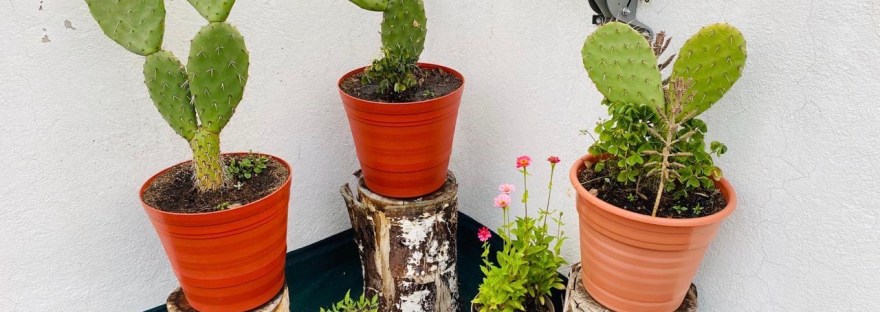
The green glow of her lettuces at sunset often fills her with verve, but sometimes she empathizes with the cilantro: since she’s in a high-risk group, her husband and the son who still lives at home barely let her out. She tears off the badly wounded leaves because to let herself be hypnotized by their ocher moods would be like going back to the bitter years in the United Arab Emirates, when the mere idea of getting sick or dying caused her such panic that she would either sink into the clutches of insomnia anchored in anxiety or into deep sleeps of up to twenty hours in order escape from reality.
There she truly had been sentenced to be alone: pushed into exile by the massive layoffs of that criminal company that, from one day to the next, put eight thousand five hundred families out on the street, without declaring bankruptcy or providing severance pay or compensation or lost wages or anything else. Even the workers’ savings accounts were robbed with the support of that thief Calderón, who was never worthy of the honor of presiding over the Mexican Republic.
In the Emirates, her children didn’t hold out for long before decamping, and her husband took endless shifts as a pilot: he was nowhere to be seen for six days at a time and then left again within hours of returning home. «Home,» in that case, served as a euphemism for «apartment infused with the imposed loneliness of existing in the middle of the sand in a country where a woman’s words are worth nothing and her value can only be in relation to a man, especially as a foreigner, which ensures the status of third-class citizen.»
She escapes these warmed-over torments thanks to the tangibility of a ripe fruit from her orchard. A few days ago she read that “avocado” in Nahuatl means “testicle,” so she savors it, basking in the etymology and avoiding looking out of the corner of her eye at the dry coriander leaves, which remind her of all the people who are dying: tens, hundreds, thousands: the figures just won’t stop rising. Through taste, she returns to her being, to her presence in Coyoacán, where she lives and where she will die, because she no longer thinks of ever dwelling or dying anywhere else on the planet.
That other time she glimpsed the grim reaper, she was trapped almost at her home’s antipodes with a depression crowned by the certainty that it would kill her. Her fear led her to make her husband swear over and over that, if death came, he would send her remains to Mexico so that her ashes could be scattered across every corner of Coyoacán; it didn’t matter if on the sidewalks, the flowerpots, the puddles or even the garbage cans: she wanted to be scattered in her beloved neighborhood, in the land that filled her with sobs and nostalgia even when she plunged into those deep dreams from which she awoke drenched in sweat and sighs, with her love for her polychromatic land deepened. If her remains were to dwell until the ends of eternity in these remote territories, it would be like dying twice over.
In the Coyoacán, immersed in helplessness, suffering through some of the worst years of her life, she got used to threading words together in the most absolute silence, and now she waits for the day to turn black and for her family to let themselves be seduced by the drooping of their eyelids so that noise will remain only a rumor of the past and of the future. And then, only then, she manages to write the portentous tiny stories and poems that spring from her fingernails into the secrecy of her bewitching twilight lair.
But there are times when the silence is shattered with noise caused by the uncertainty of tomorrow, and then she yearns for the inspirations of that world before the pandemic: she can no longer sit on the fence of the Casa de Cortés, her favorite place to people-watch and make up stories. Although all the better, actually, since the mayor’s brat has added one more massacre to his list of atrocities already committed and to be committed, disfiguring the building by covering its radiant yellow in white and removing every wisp of inspiration from the area.
During the lockdown, she has clung to literature and is more active than ever: at fifty-seven she has become a tech geek, teaching online courses, participating in virtual writing projects, and making muses of the news, longings, reminiscences, and routines. On days like today, she questions her own survival and is convinced that she will remain in this world by crystallizing herself through literature.
She has started a story — «The sweat of various bugs dripped over her webs…» but she needs to fill herself with fresh air to be able to continue it. She goes up to the roof of the building to take in the night breeze that seems so clean (pollution camouflages itself, devious, among the wonders of the night) and enjoys the sound of the trees swaying in the wind and the crickets chirping as they celebrate summer. Her house, that refuge where she narrates herself from the inside is wrapped between the warm pages of her books, the delicious swaying of her plants, and her intertwining with her family.
A summer storm reminds her that she is alive with its force of rain and the fleeting art of lightning against the violet sky; and she gently bears the ever-repeating certainty of her own death, but she refuses to succumb to its promises of rest because she doesn’t wish to leave this world just yet. Although, if she perishes now, she will have fulfilled what she has come to do: she is in her country, her children are already self-sufficient, and she has planted literary seeds here and there: she is not afraid of her departure, not at all, however, she is terrified of leaving with pain and suffering.
Safely rooted where she belongs, she allows herself the luxury of becoming finicky: if she were to die now — suddenly, please, suddenly — she wouldn’t want her remains to drift into just any hole in her neighborhood: she would love for them to swirl around the kiosk in Hidalgo Park and caress the mimes and street clowns who entertain an audience, now half absent, for a few coins; she would relish her ashes dancing among the sones and huapangos that the jaraneros rehearse in La Conchita Park; she would enjoy having them slip into the nostrils of the gringos who crowd Frida Kahlo’s house yet refuse to ever utter a single word in our language, to make them at least sneeze in Spanish.
From the tranquility of the rooftop, she feels more Coyoacanese than ever. She is happy and in the right place, even with death lurking. She meditates a little (but not too much, otherwise she will fall asleep) and says to herself that tomorrow she will flood her family with love, kisses, hugs, delicious food, and she will tell them that they already know that she is very apapachona — because she’ll if she does not fill her mouth every day with her favorite word, meaning affectionate, although exiled from the official dictionaries — and she will invent that they’re lacking something essential and will head out to the supermarket or the pharmacy just to soak her senses briefly in the urban panoply currently under siege by the lockdown.
The pandemic has not taken away even an ounce of hunger, and today Angélica dreams that the streets are free to stroll again and that she eats quesadillas at the antojitos market, a chocolate at El Jarocho, and then fig ice cream with mezcal sitting on a bench listening to the splash of the Coyotes fountain while she fills her pupils with the colorful people who, without realizing it, gift her those stories that nourish the ravenous lines of her writing.
{Translated by Adam Lischinsky}
~~~~~~~~~~~~~~~~~
More tales of the pandemic based on real stories at
Love in the Time of Coronavirus,
by Patricia Martín Rivas.

 Patricia Martín Rivas